Categories
Tech

Google Maps Tests A New Crash and Speed Camera Reporting Function

Google Maps is testing a crash and speed camera reporting function, one of the features in Waze, the app bought by Google. So, Google has not one, but two main navigation applications, including Google Maps, which it developed from scratch, and Waze, which it bought a few years ago.

The latter has a crucial advantage over Google Maps as it provides real-time traffic information, which is very useful and can be very convenient for getting a route. Traffic information, such as speed cameras, accidents, traffic jams, etc., can be reported directly by other Waze users. And it seems that Google wants to integrate some of these features into Google Maps.

According to Android Police, Google is currently testing a feature that would allow users to report accidents and speed cameras.

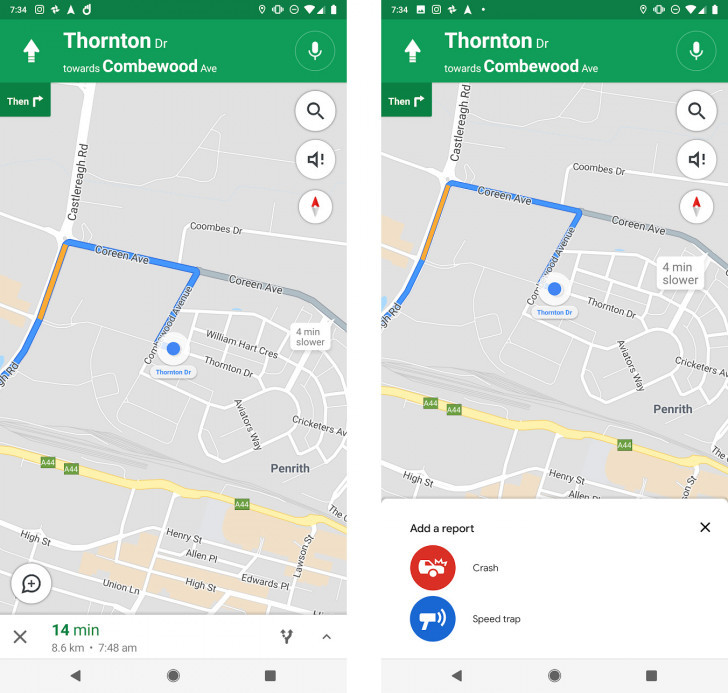
Support for incident reporting in Google Maps was first discovered several months ago, but this feature is currently being tested by some Google Maps users, as shown in the following screenshot.
Google Maps Tests A New Crash and Speed Camera Reporting Function

The new crash and speed trap (speed camera) report buttons should appear at the bottom of the maps. That allows users to tell Google if they have witnessed a road slowdown due to an accident or speed camera. The feature only works in navigation mode.

You can only notify a speed camera if you follow the path taken by the application. Since we do not need directions to find our place of residence, this means that we cannot map a radar if the navigation is off. Waze, on the other hand, allows you to report speed cameras even if the users are not in navigation mode.

The new Google Maps functionality is still being tested, and it is not known when it will be available to all Google Maps users. If you drive a lot and can use more live updates on what’s going on around you, then Waze can be a much better solution than Google Maps for reporting crashes and speed cameras.

Categories
Tech

Updating Apps While You’re Using Them Is The Next Goal for Android

Among the news coming from Samsung, Google also presented an upcoming feature in Android that would allow users to use applications as the system is updating apps. The presentation took place at Android Dev Summit as part of Android’s In-App Updates API, which is at this moment under testing by Google.

“You’ll have two options with this API; the first is a full-screen experience for critical updates when you expect the user to wait for the update to be applied immediately. The second option is a flexible update, which means the user can keep using the app while the update is downloaded. You can completely customize the update flow, so it feels like part of your app,” said Stephanie Cuthbertson, Android’s Director of Product Management.

According to The Verge, the new Android feature is a fail-safe against users who refuse to keep their apps updated as the process is requiring a few steps.

Updating Apps While You’re Using Them Is The Next Goal for Android

The In-App Updates API is currently in its testing phase at Google. When it comes out, this new Android feature will allow updating apps while you’re using them, easing up the Android apps update process.

Besides this upcoming function, at the before-mentioned Android Dev Summit, Google also presented its Foldables technology with which the company wants to support the forthcoming Samsung folding smartphone announced by Samsung Senior Vice President Justin Denison at the 2018 Samsung Developer Conference.

Even though Justin Denison did not disclose an exact release date for Samsung’s foldable smartphone, Galaxy F, Android and Google’s devs reported that the upcoming folding smartphone would hit the shelves in 2019. Also, the new Google’s Foldables technology is specially designed to support the forthcoming Galaxy F with a GUI and apps that would work with the device’s folding display.

Categories
Tech

Samsung Revealed Three “Infinity” Notch Designs and A Notchless “New Infinity” Display

The giant South Korean tech company, Samsung has just revealed four different screen designs at its 2018 developer conference. Three of these new screens come with various examples of a notch, while the fourth, “New Infinity,” is a notchless display.

The first three designs, dubbed as “Infinity-U,” “Infinity-V,” and “Infinity-O,” are showing a different notch design each. Infinity-U comes with a notch shaped like a letter “U,” Infinity-V boast a cut like a letter “V,” while the last one presents an O-shaped notch placed on the top-right side of the screen.

Interestingly, the Infinity-O design looks like the Samsung Galaxy S10 render, recently made by Ben Geskin. His render shows a Galaxy S10 device with an O-shaped notch on the top of the screen where the selfies camera would be put.

However, the notchless New Infinity display boasts a screen with almost no bezels and no notch. To be honest, this New Infinity screen looks fantastic.

Samsung Revealed Three “Infinity” Notch Designs and A Notchless “New Infinity” Display

Besides “Infinity-U,” “Infinity-V,” “Infinity-O,” and “New Infinity,” Samsung also presented its new Infinity Flex Display for its upcoming Samsung folding smartphone, the so-called Galaxy F.

As mentioned, at Samsung’s 2018 developer conference, the South Korean giant tech company presented its new designs for its Infinity display series. Each of the first three designs, dubbed as Infinity-U,” “Infinity-V,” and “Infinity-O,” boasts a uniquely-shaped notch. Besides these models, Samsung also revealed its “New Infinity” design which is a notchless screen with very thin, almost invisible, bezels.

The latter, the New Infinity display design, could be the one the fans would love the most if implemented on an upcoming Samsung design as the notches are increasingly less popular, lately.

In conclusion, Samsung revealed three Infinity notch designs and a notchless New Infinity display. One of the notch designs, the so-called Infinity-O, appeared recently, in a somewhat different form, however, in Ben Geskin’s render of Samsung Galaxy S10.

Categories
Tech

Asus Zenfone 6 Would Come With Two Cameras On The Front and The Back

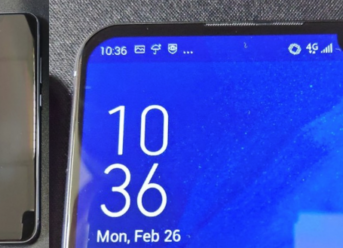
The Asus Zenfone 6 is getting closer to come to light, and recently, there have been leaked some images that have sparked speculation by fans of mobile technology.

Asus Zenfone 6 would become the flagship of the Asus brand

The device would become the flagship of the Asus brand that has been revealed and aesthetic features, showing a small tab on the top right, something that makes it quite peculiar. Since manufacturers began using the scheme notch on their devices, each new model we see in the market usually have this feature, so, this new Asus Zenfone 6, does not seem to vary too much the concept.

The device would be available to perform at the Mobile World Congress 2019 in February, it has leaked through a video that was posted on the Italian site HDblog.it. We can see a fairly stylized and apart from this discreet notch located on the front, can be made from aluminum having edges equipment.

Asus Zenfone 6 would come with two cameras on the front and on the back

It takes full advantage of your screen, while your fingerprint reader will maintain security and discretion when using your device. It may be this a prototype or possibly stand before the final model of Asus Zenfone 6, which have two rear and front cameras. As for the internal components, under the hood, not much is known, since it can only be the type of load USB Type-C, a headphone jack, and a sturdy and solid chassis aesthetically it seems to be an evolution of its predecessor.

The notch included in the upper right front is designed especially for the camera, so it is a significant improvement compared to the model Zenfone 5 which was located in the central part compared strongly with the iPhone X.

Categories
Tech

Instagram Might Launch Instagram Storied For Schools

Instagram is reportedly working on a school-only version of Instagram Stories. The new system would work in such a way that students in a school, and only them, would make collective contributions to their school’s Stories. The possible existence of this new feature has been found in the social network code by Manchun Wong, a software researcher known for the numerous social network discoveries.

Instagram, for its part, has not commented on this, which could indicate that the tool is at an early stage of development. Apparently, the idea is that schools would have a space similar to Instagram Stories in which only the students of the respective schools can upload (and see) the content. In this way, a safe space is created, out of other people’s eyes, where kids can use social networks in their community.

What Manchun Wong found in the code lines of the new Instagram Stories seems to suggest that, in order to prevent school’s Instagram Stories from becoming a bullying nest, all uploaded content would be reviewed by some human moderators, most likely, professors of the respective schools.

Instagram Might Launch An Instagram Storied Feature For Schools

That would avoid the failures of automatic moderation systems, based on artificial intelligence and user reports, and would give a safe space to the youngest.

The presence of a human team constantly monitoring the content may be a too-high investment for Instagram, but, of course, it is better than the alternative of letting bullying and harassment get away with it. Nothing has yet been confirmed, so Instagram Stories for schools could arrive at a later time, or it might never launch, in fact.

In any case, it makes sense that Instagram Stories would dedicate to a niche mostly ignored by other social networks.

Exit mobile version