Categories
News Tech

Nokia 2 Gets Android 8.1 Oreo Beta with Latest Improvements

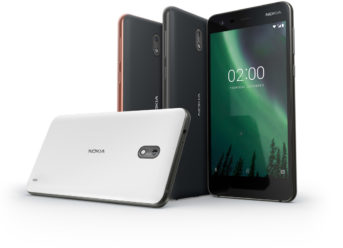
HMD Global launched Nokia 2 last year and the smartphone has been quite successful. Nokia 2 is not a high-end smartphone, but it does offer quality hardware specs which are accompanied by an affordable price and this is what makes the smartphone so popular. Nonetheless, Nokia 2 owners should be happy to know that they can get their hands on Google’s latest Android 8.1 Oreo operating system update ahead of everyone else.

Nokia 2 Receives Android 8.1 Oreo Beta

Juho Sarvikas who is the Chief Product Officer of HMD Global announced today that Nokia 2 owners can download Android 8.1 Oreo Beta. This is great news for Nokia 2 owners because it means they can get a better optimized operating system. Even though the new update might be in beta, the final build will start rolling out OTA (over the air) during the upcoming future.

Affordable Smartphone

Nearly every tech company tries to create affordable smartphones that cater to the masses. However, they all pale in comparison with the products that Nokia offers. Nokia 2 is the perfect example of how a smartphone can combine powerful hardware parts with an affordable price. With that said, let’s take a look under Nokia 2’s hood.

Hardware Power

The smartphone is powered by Qualcomm’s Snapdragon 212 CPU. This is a quad-core CPU which clocks at 1.3GHz Cortex-A7. Things get even better than this since Nokia 2’s CPU is paired with an Adreno 304 graphics processing unit and 1GB of RAM. The smartphone features 8GB of internal storage space, but Nokia fans who want more can expand it up to 128GB via a microSD card.

Display Technology

Despite being categorized as an affordable smartphone, Nokia 2 ships with a large 5.0-inches LTPS IPS LCD display which features a pixel resolution of 720 x 1280. Additionally, the display is coated in Corning Gorilla Glass 3 which enhances its resistance.

Categories
Tech

NordVPN Vs. Hide.Me – Which Is Better In 2018?

Even though all the VPNs are doing the same job, some details make one better than another for specific needs. That’s why, before subscribing for a VPN service, is wisely to review some of them. Today, I’ll present you a comparison between two of the best VPNs services out there, NordVPN and Hide.me VPN service. Let’s see which is better in 2018.

NordVPN Vs. Hide.me – Features

Hide.me is a viable and trustworthy VPN service designed for Windows, Linux, Mac, iOS, and Android and comes in two variants, one free VPN service and another Premium VPN service. Both are ads-free, which is great, by the way.

Among the most important Hide.me features, there are:

  • No activity logging even on the free version
  • One-click connections
  • Auto server and reconnect
  • Automatic Kill Switch
  • IP and DNS leak protection
  • Smoother experience on unstable connections
  • Data encryption
  • 99.99% uptime

On the other hand, NordVPN comes only in a paid version, which costs differently according to the plan you need, and is primarily dedicated to individual users and businesses of all kinds and sizes.

Among the most important NordVPN features, there are:

  • Military-Grade Encryption and CyberSec
  • Double VPN with no logs policy
  • Bitcoin (BTC) payments
  • Automatic kill switch
  • DNS leak protection
  • Streaming
  • SmartPlay
  • High-Speed VPN

NordVPN Vs. Hide.me – Prices And Plans

As said above, NordVPN comes only in paid version, as follows:

  • Simple $11.95/month
  • Best Offer $3.29/month (2-year plan)
  • Standard $5.75/month (1-year plan)
  • NordVPN for Businesses price is available only by request

All the NordVPN plans cover the following:

  • NordVPN Apps
  • 6 Simultaneous Devices
  • Dedicated IP Address
  • 24/7 Customer Support
  • High-Speed Connection
  • Unlimited Bandwidth

On the other hand, Hide.me VPN service comes in three subscription plans, as follows.

Free

  • Three locations
  • Best-effort bandwidth
  • 2 GB data volume
  • Limited support for VPN protocols
  • Only one simultaneous connection

Premium – $9.99/month

  • 30+ locations
  • Unlimited bandwidth and data volume
  • Full protocol support
  • Five simultaneous connections
  • Port forwarding

Plus – $4.99/month

  • 30+ locations
  • 75 GB Data transfer limit
  • Full protocol support
  • One simultaneous connection
  • No port forwarding

NordVPN Vs. Hide.me – Which Is Better In 2018?

Both have their ups and downs but to assess which one between NordVPN and Hide.me VPN service is better, we should also take a look at the users’ opinions regarding these two services.

NordVPN has very positive reviews and is high-rated on many reviews sites, scoring an average of 4 stars out of 5. On the other hand, the Hide.me VPN service got more mixed opinions but also a rating of around 4 stars out of 5 on average.

In conclusion, Hide.me is offering a free plan without cutting off much of the features it offers, so is ideal for individual users, while NordVPN is a complete VPN service mostly dedicated to businesses. So, decide for yourself which is better in 2018, depending on your needs.

Categories
Crypto News

This Is Why Central Banks Are Afraid Of Bitcoin (BTC)

Central banks have no love for Bitcoin (BTC) and other cryptocurrencies. While some good deeds are taking place, the general sentiment is presumably negative. The applicability of cryptocurrencies and the decentralized technologies that characterize them are questioned, mainly by banks. Central banks feel the need to control the Bitcoin (BTC) and even proposed several times a central body to put a real value on this cryptocurrency.

Bitcoin (BTC) Value Measurement

A lot of people and organizations are fighting to establish the real value of Bitcoin (BTC). A decentralized type of currency that is not issued or controlled by any central body presents many and varied challenges, but it also poses the dilemma of whether this type of currency can ever hold any real value.

For central banks, the fluctuation of the Bitcoin (BTC) price indicates its huge volatility, at least when compared to gold or other mainstream commodities.

Also, it’s obvious that gold is attracting more investors than BTC, but the crypto is still valuable, even more than gold, of course, against the USD.

The necessity for a central body to control the Bitcoin (BTC)

The lack of centralization of the Bitcoin (BTC) world is a frequent topic of discussion. More precisely, there is no central developer, firm, bank or governmental entity in charge of holding the leading digital currency in the world, at the moment.

But cryptocurrencies represent a very distinct and modern view of money. While central banks rely on people’s money to function and people rely on central banks to hold their cash, Bitcoin (BTC) and other cryptocurrencies don’t work that way, as there is no central body to control the holdings, the transactions. There is no central body to function on cryptocurrencies.

That is the first reason why central banks are afraid of BTC and cryptocurrencies.

Even more, some specialists go as far as stating that Bitcoin (BTC) is a real threat to traditional banking because it offers an alternative characterized by decentralization and freedom. But, unfortunately, blockchain technologies on which the cryptos rely must mature more before becoming a viable alternative to traditional banking.

However, in the end, keep in mind that another reason why central banks fear Bitcoin (BTC) and cryptocurrencies is that these digital assets are going on the right track to becoming viable alternatives to the traditional banking system.

Categories
Crypto News

Square And Xapo Cryptocurrency Exchange Platforms To Get BitLicense To Operate In New York Legally

New York adds two cryptocurrency exchange platforms to the five that were already operating legally. More specifically, Xapo and Square became cryptocurrency exchange platforms are next for obtaining the BitLicense. The initial approval of Square’s license came on Monday, June 18th, while Xapo received it on June 14th.

According to Maria Vullo, Superintendent of Financial Services of the New York Department of Financial Services (DFS), the agency certified Square to enter the “well regulated foreign exchange market.”

The DFS also approved the licensing of the Xapo, Inc., exchange bureau after passing revisions to “cybersecurity, anti-money laundering, anti-fraud, and consumer protection policies.”

The Paxos Trust Company, formerly known as itBit and a subsidiary of Kabompo Holdings Ltd., was also granted permission to trade in various cryptocurrencies such as Ethereum (ETH), Litecoin (LTC), Bitcoin Cash (BCH), and Stellar (XLM).

Square and Xapo cryptocurrency exchange platform to get the BitLicense to operate in New York legally

The announcements coincide with the statement of Barry Silbert, CEO of DigitalCurrencyGroup (DCG), who through his Twitter account announced the partnership of Genesis Trading with Square for the development of the application for the purchase and sale of Bitcoin (BTC), Cash App.

“Finally, the association that Genesis built over the last year with Square is revealed publicly. It has been great working with Jack Dorsey and his team,” said Silbert.

According to a press release from DCG, Genesis Trading processed the BitLicense next to Square, thus receiving approval to bid Ethereum (ETH), Ethereum Classic (ETC), Bitcoin Cash (BCH), Litecoin (LTC), ZCash (ZEC), and Ripple (XRP), although the latter is the subject of discussions between U.S. regulatory agencies, as it can be considered a security.

BitLicense is the regulatory requirement imposed in New York State for cryptocurrency exchange platforms to offer their services in this state. This measure, which has been in operation since 2015, has been the subject of criticism and controversy since it was proposed by former DFS superintendent Benjamin Lawsky, causing an exodus of companies operating in this town.

Now, Square and Xapo cryptocurrency exchange platforms are next in row to obtain the BitLicense to operate in New York legally.

Categories
Crypto Games News

Poketoshi Allows The Bitcoin Community To Play Pokemon Using The Lightning Network

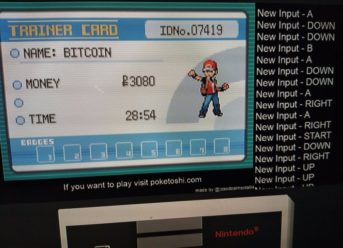
Want to play Pokemon with the Bitcoin community? Then, you should know that the Portuguese developer Joao Almeida created Poketoshi, an application for the Lightning Network micro-payment protocol that combines one of the versions of the Pokemon game with Bitcoin (BTC) payments protocol.

For its design, Almeida used OpenNode which is a service specialized in digital payment settlement for merchants using Lightning Network micro-payment protocol.

The developer shared some of the statistics generated by this application which in its first 24 hours online received 61,916 satoshis, through a total of 635 transactions.

Poketoshi allows the Bitcoin community to play Pokemon using the Lightning Network micro-payments protocol

This application is a kind of tribute to Twitch Plays Pokemon, a “social experiment” devised in 2014 by an Australian programmer who remained anonymous. Using the Twitch video game streaming platform, the idea was to allow users to play Pokemon indirectly.

The game was very successful and even holds the Guinness World Record for having “the highest number of participants in a single player online video game” with 1,165,140 users.

Poketoshi uses the same principle, but every move in the game must be paid for using the Lightning Network micro-payments protocol. The goal is to monetize the game so that the streaming service can pay for itself while allowing the Bitcoin community to use the micro-payment network directly.

100 satoshis for every move

The game’s interface has a Super Nintendo controller, through which players can make the game’s avatar moves, always by paying 100 satoshis, regardless of the button chosen.

The Portuguese developer said the original idea for the game was put forward by Nakamoto Institute President Michael Goldstein. The latter tweeted:

Lightning Network plays Pokemon. An experiment in social coordination using the skin of micropayment in the game. One satoshi per button,

Michael Goldstein, on Twitter

In short, Poketoshi allows Bitcoin community to play Pokemon using the Lightning Network micro-payments protocol.

Exit mobile version